
Brands that are manufacturing and distributing cigarettes need to understand the full dimensional landscape of cigarette products. Even if you are a manufacturer of custom cigarette boxes, understanding these things is non-negotiable for you. Even if you select the wrong size of the box by one millimetre, you will have to face several consequences of this. This is because your cigarettes will not be placed in the packaging. It can also happen that the lids don’t flush close, and the tactile quality of premium tobacco brands evaporates entirely. In this blog, we will understand a standard size chart of the boxes and the dimensions by the type of market. From compliance to design decision, everything will be discussed today!
Standard Cigarette Dimensions: The Complete Size Chart
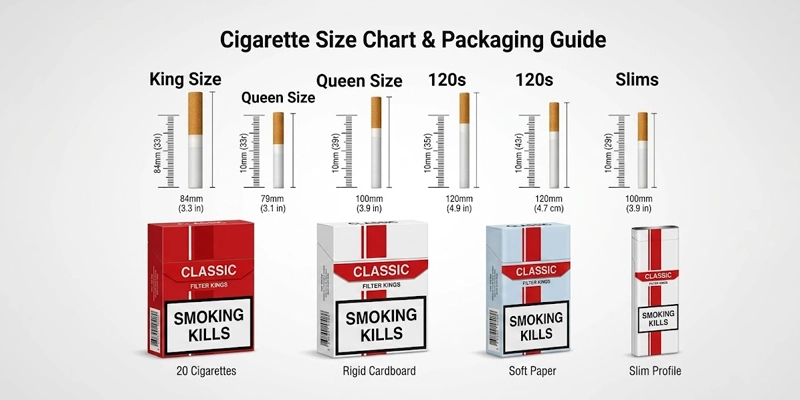
Cigarettes are manufactured to precise dimensional standards that have evolved over decades of market development. These dimensions determine how the cigarette smokes and in what way the cigarette boxes must be manufactured to hold it securely. The boxes must prevent cigarette movement and deformation during transit and retail handling. Based on the type of cigarettes, the following are the common cigarette sizes:
| Type | Length (mm) | Length (inches) | Tobacco Weight |
| Regular | 70mm | 2.75″ | 0.65-0.70g |
| King Size | 84mm | 3.31″ | 0.70-0.80g |
| 100s | 100mm | 3.94″ | 0.85-0.90g |
| 120s | 120mm | 4.72″ | 1.00-1.10g |
King-size cigarette lengths are 84 mm and are one of the dominant global standards. This size was adopted during the market shift of the 1960s and 1970s from its original format of 70mm. Most of the boxes are manufactured for this size. When you see a brief that says “standard cigarette box,” you can assume 84mm as the size. Considering the format, cigarettes have the following diameters:
| Format | Diameter (mm) | Circumference (mm) |
| Regular / King Size | 7.8-8.0mm | 24.5-25.1mm |
| Slim | 5.4-6.0mm | 17.0-18.8mm |
| Super Slim | 5.0-5.1mm | 15.7-16.0mm |
| Micro | 4.6mm | 14.5mm |
Diameter is the single most critical dimension for inner box tolerance. A box manufactured for standard 8mm cigarettes will allow slim cigarettes to rattle and shift. This will compromise the structural integrity and the perceived quality of the product. Cigarette boxes wholesale must specify interior clearance and insert a channel that matches precisely to the cigarette diameter being packaged.
Filter Dimensions
The filter represents approximately 20-27mm of total cigarette length and typically matches the cigarette diameter. For custom packaging with visible windows or display apertures, the filter diameter determines the minimum opening size. This is required for product visibility without structural compromise.
Standard Cigarette Pack Dimensions
The outer dimension of the boxes is determined by the number of cigarettes and their diameter. Aside from this, the structural requirement of the selected cardboard cigarette boxes impacts the overall dimensions of the boxes. Below are the industry-standard pack dimensions for 20-count packs:
| Market | Width | Height | Depth |
| North America (Imperial) | 3.63″ | 2.83″ | 0.83″ |
| North America (Metric) | 92mm | 72mm | 21mm |
| Europe / UK (Metric) | 88mm | 55mm | 23mm |
| Australia (Metric) | 85mm | 58mm | 21mm |
The variation between North American and European standard dimensions reflects different count configurations and structural conventions, not simply unit conversion. European packs are taller and narrower. On the other hand, North American packs are wider and shallower.
Extended Count Packs
| Count | Approximate Dimensions (mm) |
| 10-pack | 86mm × 55mm × 12mm |
| 25-pack | 86mm × 66mm × 23mm |
| 30-pack | 86mm × 76mm × 23mm |
| 50-pack | 86mm × 120mm × 25mm |
10-cigarette packs have been banned in the UK since May 2017 and are restricted in multiple EU markets under the Tobacco Products Directive. The Tobacco Product Directive mandates a minimum of 20 cigarettes per retail unit.
Carton Dimensions
A standard cigarette carton contains 10 packs of 20 cigarettes, which means they have 200 total. A single carton measures approximately 150mm × 90mm × 205mm. Japanese market cartons frequently hold 25 packs that contain 500 cigarettes) and require correspondingly larger carton dimensions. Your personalized cigarette boxes that are made of corrugated or other high-end materials are used to protect the inner packs during distribution.
Cigarette Box Structures
Understanding dimensions alone is not enough to specify a cigarette box. The structural format and the box style determine:
- How the box is manufactured
- How it opens
- How it presents the product
- How it accommodates regulatory requirements, including tax stamps and health warnings
Flip-Top Or Hinged Lid Box
The hinged-lid or flip-top box is the global standard for premium cigarette packaging. It consists of an outer box with a hinged top panel that lifts open from the front. Flip-top incorporates a shoulder and neck. An inner frame is visible above the cigarettes when the lid is open, which adds structural rigidity and is characteristic of the classic hard-pack aesthetic.
The flip-top structure requires a die-cut and score pattern. A die-cut score is more complex than a standard tuck end folding carton. Make sure that the hinge is scored precisely to open and close at the correct angle without cracking the board. Aside from this, the shoulder panel must be glued accurately to the inner frame during production.
Calliper specification
Flip-top cigarette boxes are typically produced from 300-350gsm of Solid Bleached Sulphate) board. This provides the rigidity required for the hinged manufacturing and through the maintenance of square corners through repeated opening and closing.
Soft Pack
The soft pack is a foil-and paper-wrapped bundle without a rigid outer board. It is produced through a wrapping rather than a box-making process and uses an inner foil liner laminated to paper or thin board. Soft packs are less common in premium markets but remain prevalent in price-sensitive segments. They require foil lamination and a crimping or folding machinery process distinct from rigid box production.
Slide Box Or Drawer Style
The slide or drawer box has an outer sleeve and an inner drawer tray. This format is used for limited-edition and branded gift sets. It allows for a premium unboxing experience, as the drawer reveals the cigarettes as it is extended. The outer sleeve provides a full-bleed print surface with no structural interruption. This makes it popular for brands which can invest in high-quality packaging as a brand asset.
Tuck-End Folding Carton
This box style is used primarily for promotional or economy cigarette formats. The tuck-end folding carton is the most cost-efficient structure. Tuck end boxes are flat-ships and are assembled in-line during packing. These boxes are less rigid than a flip-top and can be produced in high volumes at lower tooling cost. You can select standard offset or digital printing efficiently to design them.
Materials And Inner Liner Specifications
You can select the material and other specifications of the boxes for a high-end and alluring product presentation. These not only give catchiness to the packaging, but also ensure that your product remains in the perfect conditions:
Outer Board
Commercial cigarette boxes are produced almost exclusively from Solid Bleached Sulphate) board. This board is coated on the outer face to support high-resolution printing. The calliper or thickness ranges from 300gsm to 400 gsm, which depends on the box style:
- Flip-top hard packs have 330-360 gsm
- Slide boxes have an outer sleeve of 350-400gsm and an inner tray of 250-300gsm
- Tuck-end cartons have 280-320gsm
Coated Kraft is used for brands with a natural or eco-positioned aesthetic. Brands pair a brown kraft reverse with a clay-coated printable outer face to facilitate printing.
Inner Foil Liner
The inner foil liner is one of the most important parts of the packaging. They are laminated with aluminum foil that has a 30 to 35 gsm thickness. Some brands use metalized paper that is low in cost and a lighter alternative.
- Structural element of the cigarette pack
- Metallic inner wrap that preserves freshness
- Prevents moisture loss
- Prevent odour transfer
The inner liner is a functional specification, not merely decorative. For brands producing custom cigarette boxes, the inner liner specification is as important as the outer board grade.
Child-Resistant Packaging
The US market requires child-resistant clothes for taco packaging. This means a flip-top lid with a push-to-open mechanism is the best option. Aside from this, a recessed button or squeeze-release tab is also used that prevents children from accessing packs while remaining accessible to the children.
Printing Processes For Cigarette Packaging
Cigarette packaging is among the most technically demanding in the printing industry. Brand owners invest significantly in print quality because the pack is the primary physical brand touchpoint for a product that is purchased frequently.
| Printing Process | Volume Capacity | Colour Quality | Production Benefit | Brand Usage |
| Gravure Printing | Massive Runs | Saturated Colours | Cylinder Precision | Premium Branding |
| Offset Lithography | Medium Volumes | Sharp Details | Flexible Setup | Custom Packaging |
| Foil Stamping | Metallic Effects | Luxury Finish | Heat Application | Logo Enhancement |
| Emboss Deboss | Tactile Texture | Raised Patterns | Structural Depth | Premium Appearance |
| Soft Lamination | Velvet Texture | Smooth Surface | Surface Protection | Luxury Positioning |
| Tax Panels | Legal Compliance | Defined Areas | Stamp Placement | Market Regulation |
What Packaging Must Comply With
Plain packaging legislation has fundamentally reshaped cigarette box design in an expanding number of markets:
| Regulation Area | Packaging Rule | Design Restriction | Allowed Focus | Compliance Purpose |
| Australia 2012 | Plain Packaging | Logo Prohibition | Interior Finishes | Smoking Reduction |
| France 2016 | Standard Colours | Foil Restriction | Structural Variation | Public Awareness |
| UK 2017 | Font Control | Emboss Removal | Opening Mechanisms | Health Protection |
| Ireland 2017 | Uniform Appearance | Branding Limits | Liner Quality | Consumer Deterrence |
| Canada 2019 | Olive Exterior | Finish Ban | Box Structure | Regulatory Compliance |
| Warning Panels | Image Coverage | Display Limits | Legal Messaging | Risk Communication |
How Custom Cigarette Box Dimensions Affect Your Packaging Order
When you are selecting a cigarette box, you have to be careful about the box specifications. To avoid any errors, confirm the following specifications before the line production:
Cigarette Format And Count
Whether you are manufacturing king-size or another length. Also, make sure to select the right interior dimensions that will directly impact your measurements. From 10 to 50 packs of cigarettes, select the number of cigarettes you are going to select a packaging for. The count and how long a cigarette is will determine the width and height of the box.
Box Style And Board Specifications
Different box styles have differing printing requirements, so the die line must be done accordingly. Besides this, the served GSM also impacts the inner space of the box. You also have to see the type of inner foil liner.
Regulatory Market
The regulatory market also has certain demands that need to be kept in mind. This is because the regulatory authority demands the printing of health warnings. For this, you have to select warning panel dimensions and tax stamp pane allocation.
Providing these specifications upfront eliminates the single largest source of delay and error in cigarette box production. This means your box dimensions will not mismatch between the pack specification and the cigarette product.
Order Custom Cigarette Boxes From Premium Custom Boxes
At Premium Custom Boxes, we produce custom cigarette packaging manufactured to precise dimensional specifications. We ensure that each and every specification of the box is based on the customer’s product specifications and regulatory requirements compliance. Get your free custom cigarette box quote from Premium Custom Boxes today.